

Renting Long-Term In Cairo As A Saudi: Contracts, Deposits, And Tenant Rights
What Does It Feel Like To Look For A Long-Term Home In Cairo?
The first time you seriously start looking for a long-term apartment in Cairo, the excitement can quickly turn into a list of questions.
How much should the deposit be?
What happens if the landlord wants to increase the rent?
Is the contract legally binding?
What if something breaks?
And perhaps the biggest question of all: how do you make sure the apartment you choose really feels like home instead of becoming a source of stress?
Cairo can be an exciting place to settle into. The city is full of neighborhoods with completely different personalities, from busy central areas to quieter residential communities. But renting for several months or longer is different from booking a hotel or furnished apartment for a short stay.
A long-term lease means understanding what you’re signing, what you’re paying, and what happens when the agreement eventually comes to an end.
If you’re a Saudi citizen planning to rent long-term in Cairo, you don’t need to approach the process with fear. You simply need to slow down, read the agreement carefully, and make sure the important details are written down.
This guide explains the basics of long-term renting in Cairo, including contracts, deposits, rent increases, move-out arrangements, and practical tenant protections.
Disclaimer: This article is for general educational purposes only and isn’t a substitute for advice from a qualified lawyer or other professional familiar with Egyptian tenancy law.
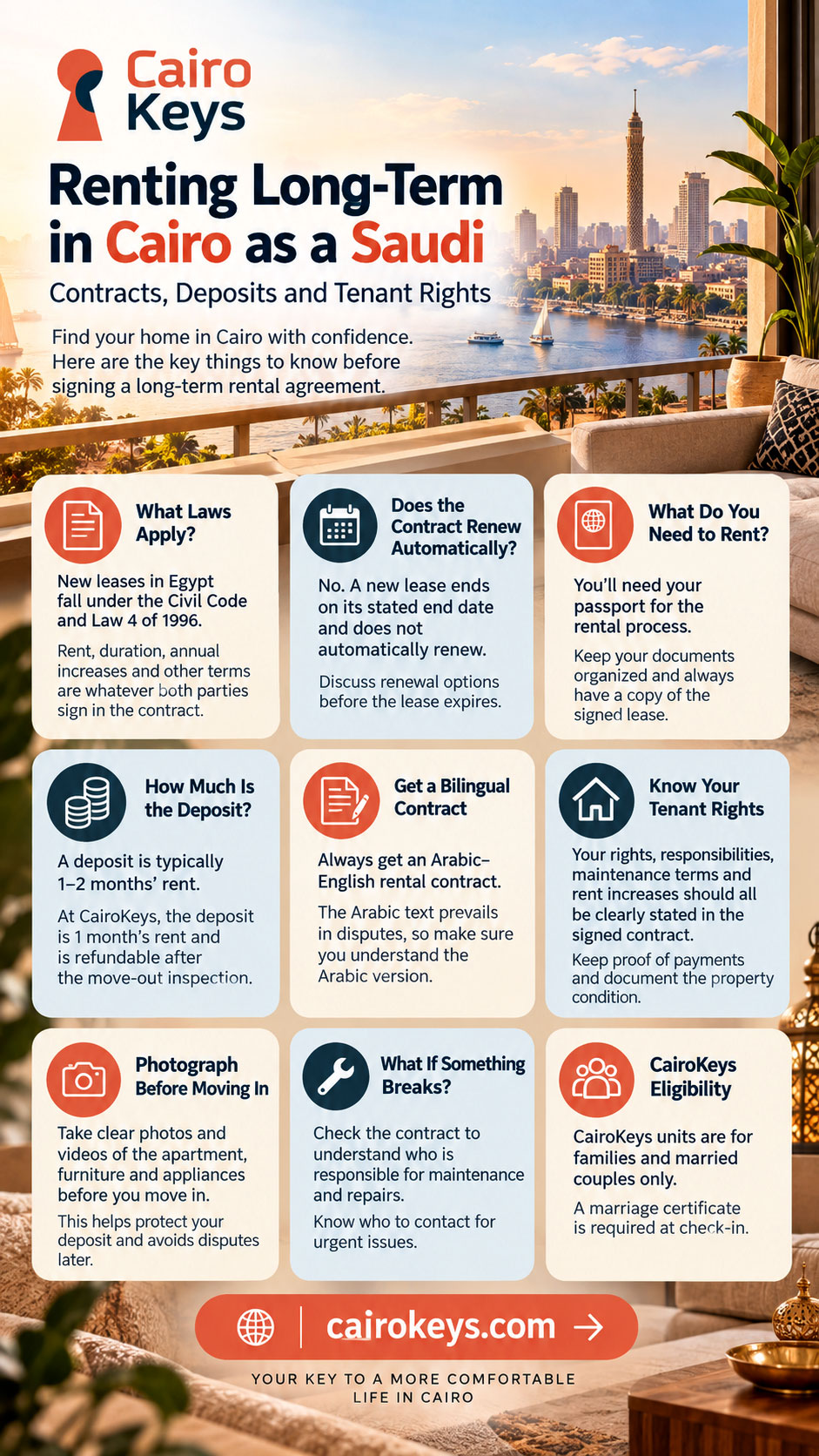
What Laws Apply To A New Long-Term Lease In Cairo?
New leases in Egypt are generally governed by the Egyptian Civil Code and Law 4 of 1996.
For a tenant, the important point isn’t simply knowing the names of the laws. It’s understanding what they mean when you’re sitting across from a landlord or property manager with a contract in front of you.
For new leases, many of the key terms are determined by what both parties agree to and sign.
That includes things such as:
- The monthly rent
- The duration of the lease
- Any agreed annual rent increase
- Deposit requirements
- Payment arrangements
- Responsibilities for maintenance
- Conditions for ending the agreement
- The condition of the apartment
- Other terms included in the signed contract
This is why reading the contract matters so much.
A verbal promise can feel reassuring when you’re standing in a beautiful apartment imagining where your furniture will go. But once you move in, memories of conversations can become surprisingly unclear.
A written agreement gives both sides something concrete to refer back to.
Does A Cairo Rental Contract Automatically Renew?
One important point to understand is that a new lease ends on its stated end date and does not automatically renew simply because you have been living in the apartment.
That makes the lease duration especially important.
Before signing, look carefully at:
- The exact starting date
- The exact ending date
- Whether the agreement allows an extension
- How much notice is required if either party doesn’t want to continue
- What happens if you leave before the agreed end date
- Whether a new contract is required for another rental period
Don’t just look at the number of months.
Look at the actual dates.
If your contract runs from January 1 to December 31, for example, that’s much clearer than simply saying “one year.”
And if you know you’ll probably stay longer, ask about renewal before you’re close to the end of the lease.
Planning ahead can save you from trying to solve a housing problem when your belongings are already packed into boxes.
What Should A Saudi Tenant Bring When Renting In Cairo?
For a long-term rental, you’ll generally need your passport as part of the rental process.
Keep your documents organized before you start signing anything.
It can help to have:
- Your valid passport
- Copies of important identification documents
- Payment records
- A copy of the signed lease
- Contact details for the landlord or property manager
- Any required supporting documents
- A written record of the apartment’s condition at move-in
Having your own copy of every important document may sound like a small thing.
It isn’t.
When you’re living in another country, paperwork becomes even more important because you may not be familiar with every local process.
A folder on your phone and a secure cloud backup can make a surprising difference.
How Much Is The Rental Deposit In Cairo?
A security deposit is commonly around one to two months’ rent, although the exact amount depends on the property and the agreement.
At CairoKeys, for example, the deposit is one month’s rent and is refundable after the move-out inspection.
The important word here is refundable.
Before paying a deposit, make sure the contract clearly explains:
- The amount of the deposit
- When it must be paid
- What the deposit is intended to cover
- The conditions for receiving it back
- When it will be returned
- Whether deductions can be made
- How damage is assessed
A deposit shouldn’t feel like money disappearing into a black hole.
You should understand exactly what happens to it from the moment you pay it until the moment you leave.
What Can Cause A Deposit To Be Deducted?
This depends on the rental agreement and the condition of the property.
Generally, the deposit may be relevant if there is damage beyond ordinary use, unpaid amounts, missing items, or other costs specifically covered by the agreement.
That’s why the move-in inspection matters.
Imagine walking into your new apartment on the first day. The walls look perfect at first glance, but there’s a small mark behind the bedroom door. One kitchen cabinet doesn’t close properly. A lamp has a crack that you didn’t notice during the viewing.
Take photographs.
Make notes.
Tell the landlord or property manager.
The goal isn’t to be difficult.
It’s to create a clear record of what was already there before you moved in.
That record can become extremely useful when it’s time to move out.
Should You Photograph The Apartment Before Moving In?
Yes.
Taking photographs and videos before you fully move in is one of the simplest habits a long-term tenant can develop.
Document things such as:
- Walls and floors
- Furniture
- Appliances
- Kitchen cabinets
- Bathroom fixtures
- Windows and doors
- Air-conditioning units
- Existing scratches or stains
- Electronics or other supplied equipment
- Utility meters, where applicable
Make sure the images are clear and dated if possible.
If the apartment is furnished, don’t assume that the furniture’s condition is too obvious to mention.
A small scratch today can become a disagreement months later.
A photograph can explain the situation much more easily than an argument can.
Why Is An Arabic–English Rental Contract Important?
For a Saudi tenant renting in Cairo, a bilingual contract can make the entire experience easier to understand.
Whenever possible, ask for an Arabic–English rental contract.
This allows you to read the agreement in a language you’re comfortable with while also having the Arabic version available for legal and practical purposes.
One particularly important detail is that the contract should clearly state which language controls if the two versions differ.
For CairoKeys, the Arabic text prevails in disputes.
That means you shouldn’t simply skim the Arabic version and rely entirely on the English translation.
If something is important to you, make sure you understand what the Arabic contract actually says.
If a clause seems unclear, ask about it before signing.
And if the wording concerns a significant legal obligation, getting professional advice can be worthwhile.
What Should You Check Before Signing The Contract?
This is the moment to slow down.
You may be tired after viewing several apartments. You may already be imagining yourself relaxing on the sofa. You may worry that asking too many questions will somehow make the process awkward.
Ask anyway.
Before signing, check:
- Monthly rent
- Payment dates
- Lease start date
- Lease end date
- Deposit amount
- Deposit refund conditions
- Annual increase, if any
- Utility responsibilities
- Maintenance responsibilities
- Furnished items included
- Rules concerning guests
- Early termination conditions
- Renewal arrangements
- Move-out requirements
- Notice periods
- Any administrative or additional fees
If something was promised during the viewing, ask for it to be included in writing.
This is especially important for things like repairs, furniture replacements, appliances, parking, internet, utilities, or other services.
If it matters to you, put it in the contract.
Can The Landlord Increase The Rent Every Year?
The annual rent increase should be based on what both parties agree to and sign in the lease.
This is one reason you should never skip the section dealing with rent increases.
An apartment might seem affordable when you first see the monthly price. But if the contract includes an annual increase, your actual long-term housing cost may be different.
Before signing, ask:
Is the rent fixed for the entire lease?
Or:
Does the rent increase after a certain period?
If there is an increase, check exactly how it works.
Don’t rely on a casual statement such as “we’ll discuss it next year.”
The written agreement should tell you what you need to know.
What Are Your Practical Rights As A Tenant?
Tenant rights aren’t only about what happens when something goes wrong.
They also begin with having a clear agreement.
As a tenant, you should know what you’ve agreed to pay, how long you can occupy the property under the lease, what services or furnishings are included, and what responsibilities belong to you and the landlord.
The contract is your starting point.
For everyday renting, practical protections include:
- Having a copy of the signed lease
- Keeping proof of rent payments
- Documenting the property’s condition
- Getting important promises in writing
- Understanding your maintenance responsibilities
- Understanding the landlord’s responsibilities
- Knowing the lease’s end date
- Understanding deposit conditions
- Keeping records of communications about significant issues
If a serious dispute develops, don’t assume that a friendly conversation or a message on your phone will resolve everything.
For significant legal disagreements, professional legal advice can help you understand your position under Egyptian law.
What If Something Breaks In The Apartment?
This is where unclear contracts can become frustrating.
A washing machine stops working.
The air conditioner begins leaking.
A water fixture needs repair.
Who pays?
The answer can depend on the circumstances and the terms of your agreement.
Before moving in, understand how maintenance is handled.
Ask:
- Who handles normal maintenance?
- Who pays for repairs?
- What counts as tenant damage?
- Who should you contact when something breaks?
- Is there an emergency contact?
- How quickly should urgent problems be reported?
- Are certain appliances covered by specific conditions?
Don’t wait until something breaks to discover that nobody knows who is responsible.
Are There Special Rental Requirements For CairoKeys Units?
If you’re considering a CairoKeys unit, there is an important eligibility requirement to know before making plans.
CairoKeys units are for families and married couples only, and a marriage certificate is required at check-in.
That means this isn’t something to discover after you’ve already arranged your travel, paid money, and packed your bags.
Check the eligibility requirements before booking or signing.
For married Saudi couples, having the required documentation available can help make check-in smoother.
The broader lesson is useful for any rental: always ask whether the property has specific occupancy or documentation requirements.
What Should You Do Before Moving Out?
Moving out deserves almost as much attention as moving in.
Don’t simply hand over the keys and hope everything works itself out.
Start by checking the contract for the required move-out process.
Then:
- Confirm your move-out date
- Give any required notice
- Pay outstanding amounts
- Remove your belongings
- Clean the apartment according to the agreement
- Return keys and access cards
- Take photographs after the apartment is empty
- Record the condition of the property
- Attend the move-out inspection when possible
- Ask about the deposit refund process
- Keep proof that the apartment was handed back
If your deposit is refundable after an inspection, the inspection becomes an important part of the process.
Take your time.
A few photographs and a clear handover record can provide peace of mind after you’ve left.
How Can Saudi Tenants Avoid Common Rental Problems In Cairo?
Most rental problems aren’t caused by one dramatic mistake.
They often begin with tiny assumptions.
“I thought the rent included that.”
“I thought the contract renewed automatically.”
“I thought the deposit was refundable.”
“I thought they would fix it before I moved in.”
“I thought the English version was exactly the same.”
Those assumptions can become expensive.
A better approach is simple:
Don’t assume. Ask. Then put the answer in writing.
Before signing, make a checklist and work through it slowly.
You don’t need to become an expert in Egyptian property law.
You just need to understand the agreement you’re entering.
What Are The Most Important Things To Remember?
If you’re renting long-term in Cairo, keep these points close:
- New leases are governed by the Egyptian Civil Code and Law 4 of 1996.
- Rent, duration, and agreed annual increases should be clearly stated in the signed lease.
- A new lease ends on its stated end date and doesn’t automatically renew.
- Your passport is required for the rental process.
- Deposits are commonly around one to two months’ rent.
- At CairoKeys, the deposit is one month’s rent and is refundable after the move-out inspection.
- Request a bilingual Arabic–English contract.
- Pay attention to the Arabic version because the Arabic text prevails in disputes at CairoKeys.
- Photograph the apartment before moving in.
- Keep receipts and payment records.
- Put important promises and repairs in writing.
- Understand who is responsible for maintenance.
- Check the move-out and deposit procedures before signing.
- If you’re using CairoKeys, remember that its units are for families and married couples only, with a marriage certificate required at check-in.
Frequently Asked Questions About Renting In Cairo As A Saudi
Do Saudi Citizens Need A Passport To Rent In Cairo?
Yes. Your passport is required for the rental process, so keep it available when arranging a long-term lease.
How Much Is A Typical Rental Deposit In Cairo?
A deposit is typically around one to two months’ rent, depending on the property and agreement. At CairoKeys, the deposit is one month’s rent and is refundable after the move-out inspection.
Does A Cairo Rental Contract Automatically Renew?
No. A new lease ends on its stated end date and doesn’t automatically renew. If you want to stay longer, discuss renewal arrangements before the lease expires.
Should My Rental Contract Be In Arabic And English?
A bilingual Arabic–English contract is recommended so you can understand the agreement clearly. Pay particular attention to the Arabic wording, especially because the Arabic text prevails in disputes at CairoKeys.
Can Rent Increase Every Year?
An annual increase can be included if both parties agree to it in the signed lease. Check the contract carefully to see whether an increase applies and how it is calculated.
What Should I Do If I Find Damage Before Moving In?
Take clear photographs and notify the landlord or property manager before or immediately after moving in. Ideally, record existing damage in the move-in documentation.
When Is The Rental Deposit Returned?
The timing and conditions depend on the rental agreement. At CairoKeys, the deposit is refundable after the move-out inspection, subject to the applicable conditions.
Can A Single Person Rent A CairoKeys Unit?
CairoKeys units are for families and married couples only. A marriage certificate is required at check-in.
What Happens If There Is A Dispute With The Landlord?
Start by reviewing the signed contract and keeping records of payments, messages, inspections, and other relevant documents. For a significant legal dispute, consider speaking with a qualified professional familiar with Egyptian tenancy law.
Is Long-Term Renting In Cairo Easier When You Know What To Expect?
There will always be a little uncertainty when renting a home in another country.
That’s normal.
You may worry about the contract. You may wonder whether you’re paying a fair deposit. You may read the same clause three times because you’re not completely sure what it means.
Take a breath.
You don’t have to know everything before you begin.
You just need to ask the right questions, keep good records, and avoid rushing through the parts that matter.
A home should give you somewhere to rest, not another problem to carry around.
So read the contract.
Photograph the apartment.
Keep your receipts.
Understand the deposit.
Know your dates.
And if something isn’t clear, ask before you sign.
The goal isn’t to approach renting with suspicion. It’s to approach it with clarity.
Because when the paperwork is clear, the expectations are clear, and both sides understand their responsibilities, you can spend less time worrying about the lease and more time enjoying your life in Cairo.
You aren’t just renting four walls.
You’re creating a place where your days can settle into a rhythm.
And with a little preparation, that process can feel much less overwhelming.