

Medical Tourism in Cairo: A Guide for Saudi Patients
The suitcase is open on the bed, but this isn’t an ordinary trip.
Inside are clothes, a passport, medication, medical reports, scans, prescriptions, and perhaps a folder filled with months—or years—of questions. There may be excitement about finally seeing another specialist, but there may also be fear. What if the treatment doesn’t work? What if communication becomes difficult? What if something goes wrong far from home?
For Saudi patients considering medical tourism in Cairo, those feelings matter just as much as flight times and hospital appointments.
Traveling for healthcare isn’t simply about finding a doctor in another country. It’s about placing your health in unfamiliar hands while trying to feel safe, informed, and in control.
The good news is that Cairo offers a large and varied healthcare landscape, Arabic-speaking medical professionals, established specialist services, and relatively easy cultural familiarity for Saudi travelers.
But familiarity should never replace careful planning.
This guide explains what Saudi patients should know before choosing medical treatment in Cairo, from selecting a healthcare facility and preparing medical records to understanding costs, accommodation, follow-up care, and the journey home.
Medical Disclaimer: This article is for general educational purposes only. It isn’t a substitute for personalized medical advice, diagnosis, or treatment from a qualified healthcare professional.
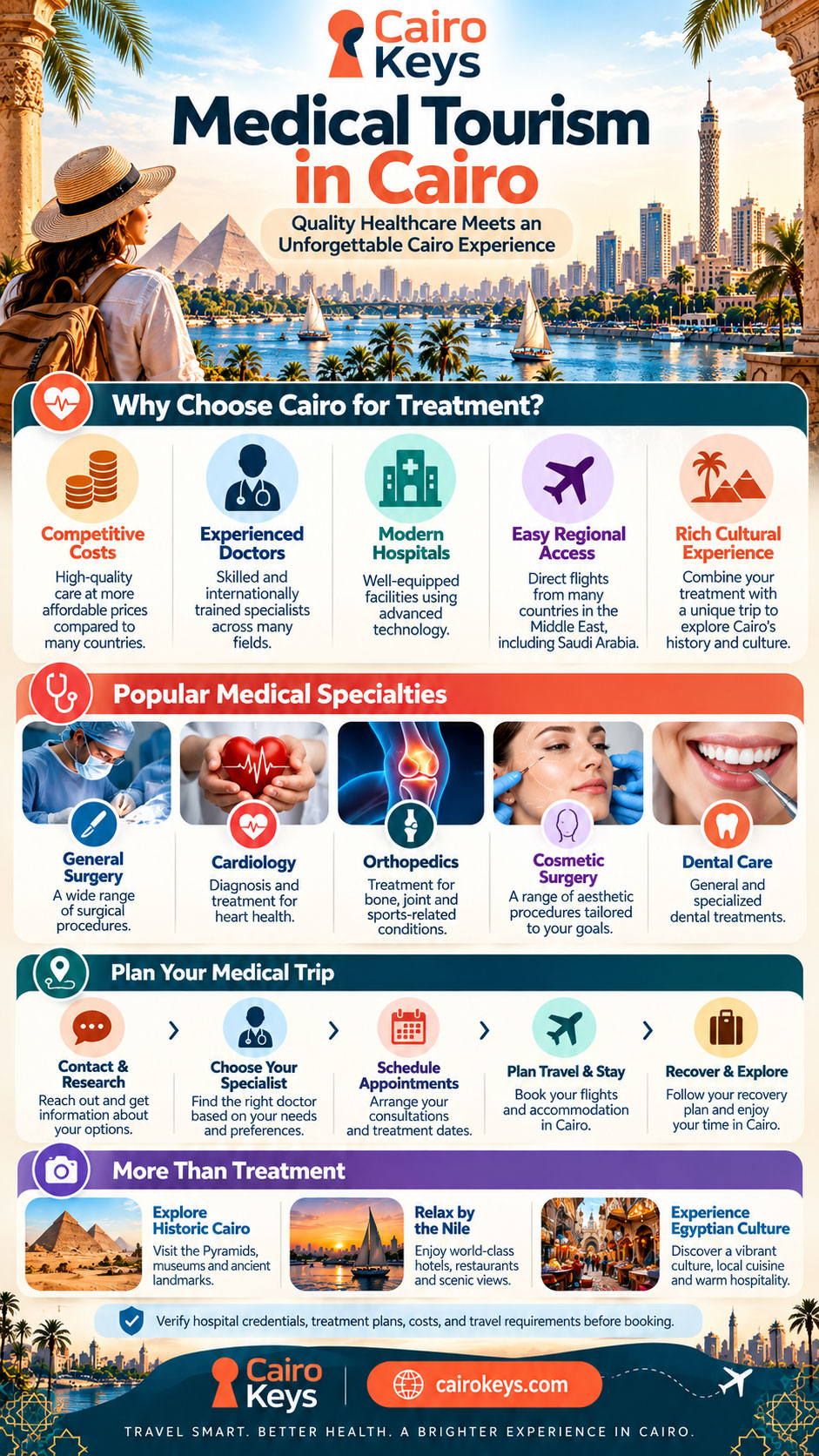
Why Do Saudi Patients Consider Medical Tourism in Cairo?
Choosing to travel for treatment is rarely one simple decision.
Sometimes a patient wants another medical opinion.
Sometimes they’re looking for a particular specialist, procedure, rehabilitation program, dental treatment, or treatment plan.
And sometimes the decision is practical. Cairo is geographically close to Saudi Arabia, Arabic is the everyday language, and many Saudi travelers already understand Egyptian culture.
That familiarity can make an intimidating medical journey feel a little less foreign.
Egypt also has a substantial healthcare sector encompassing university hospitals, government institutions, specialist centers, private hospitals, laboratories, imaging facilities, rehabilitation services, and outpatient clinics.
Egypt has continued developing formal healthcare quality standards through the General Authority for Healthcare Accreditation and Regulation, known as GAHAR. Its 2026 standards for specialized medical centers and day-surgery facilities were developed around patient safety and healthcare quality, while GAHAR accreditation has continued expanding across Egyptian healthcare facilities.
That doesn’t mean every hospital or clinic provides the same level of care.
And that’s an important distinction.
Choosing Cairo isn’t the same thing as choosing the right healthcare provider in Cairo.
The facility, physician, treatment, accreditation status, aftercare arrangements, and individual patient’s medical needs still have to be evaluated carefully.
What Types of Medical Care Can Patients Find in Cairo?
Cairo’s enormous healthcare system means patients can find providers working across a broad range of specialties.
Depending on the hospital or specialist, these may include:
- Cardiology and cardiovascular surgery
- Orthopedics and joint care
- Neurosurgery and neurology
- Oncology
- Ophthalmology
- Gastroenterology
- Urology
- General and specialized surgery
- Dentistry and oral surgery
- Fertility and reproductive medicine
- Rehabilitation and physiotherapy
- Diagnostic imaging
- Laboratory testing
- Weight-management and bariatric procedures
- Dermatology and cosmetic procedures
Availability alone, however, shouldn’t determine where you receive treatment.
A beautiful website doesn’t prove clinical quality.
A famous doctor’s name doesn’t tell you everything about the hospital where a procedure will take place.
And a low package price doesn’t tell you what happens if complications occur.
Those questions matter.
How Should You Choose a Hospital or Clinic in Cairo?
When pain, fear, or uncertainty has followed you for months, the temptation to accept the first promising answer can be powerful.
Someone finally says, “We can help.”
Those four words can feel like someone opening a window in a room that has been dark for too long.
But this is exactly when you need to slow down.
Before booking treatment, ask the hospital or clinic for specific information about the doctor, facility, procedure, and expected recovery.
Check The Doctor’s Credentials
Ask for the physician’s:
- Full name and specialty
- Professional qualifications
- Relevant medical registration
- Experience with your specific condition or procedure
- Hospital affiliation
- Expected role in your treatment
- Follow-up arrangements
If surgery is involved, ask who will actually perform it.
Don’t assume the doctor conducting your online consultation will necessarily perform every part of your procedure.
Check The Facility’s Accreditation
Ask whether the healthcare facility currently holds accreditation and which organization issued it.
In Egypt, GAHAR provides a national healthcare accreditation framework, with standards focused on areas including healthcare quality and patient safety. International accreditation may also be relevant for individual facilities.
Verify accreditation directly rather than relying only on a logo displayed on a clinic’s website.
Accreditation doesn’t guarantee a perfect outcome.
What it can do is give you another meaningful piece of information when assessing a facility’s quality systems.
Ask About Complications
This conversation isn’t pleasant, but it’s necessary.
Ask:
- What are the most common complications?
- What serious complications are possible?
- What happens if I need intensive care?
- Is emergency care available at the same facility?
- Who treats complications after the procedure?
- Are complication-related costs included?
- How long should I remain in Cairo afterward?
- Who can I contact after returning to Saudi Arabia?
A trustworthy medical team should be willing to discuss risks as well as benefits.
What Medical Documents Should Saudi Patients Bring?
Imagine arriving at your consultation only to discover that the specialist needs an MRI you left in Saudi Arabia.
Suddenly, something small becomes another test, another appointment, another expense, and another exhausting day.
Medical travel is easier when your history travels with you.
Create both digital and physical copies of important documents where possible.
| Document | Why It Matters |
|---|---|
| Passport and identification | Travel and hospital registration |
| Recent medical reports | Gives doctors an overview of your condition |
| Imaging reports and original images | Helps specialists review previous findings |
| Laboratory results | Prevents unnecessary repetition where appropriate |
| Medication list | Helps identify interactions and treatment considerations |
| Allergy information | Important for medication and anesthesia safety |
| Previous surgical reports | Provides important procedural history |
| Pathology reports | Particularly important for cancer-related treatment |
| Current treatment plan | Helps coordinate care |
| Insurance or authorization documents | Needed when third-party payment applies |
| Doctor contact details in Saudi Arabia | Useful for continuity of care |
Don’t simply write “blood pressure medicine” or “painkiller.”
Record medication names, doses, and how often you take them.
That small detail can matter more than you think.
Do Saudi Patients Need Approval Before Traveling For Treatment?
This depends on how the treatment is being funded and the patient’s circumstances.
Saudi patients seeking officially funded treatment abroad follow Saudi government procedures. Saudi Ministry of Health rules distinguish between treatment abroad at personal expense and treatment authorized at government expense.
For officially supported treatment abroad, formal medical review and authorization requirements can apply.
Even patients planning to pay privately should check current Saudi requirements before committing to travel, particularly if their condition is serious or ongoing.
Rules can change.
Don’t build an expensive medical trip around something someone told you several years ago.
Confirm current requirements through the relevant Saudi authorities before departure.
What About Entry Requirements For Egypt?
Saudi travelers should verify Egypt’s current entry and visa requirements before booking flights or paying non-refundable medical deposits.
Your passport should meet the applicable validity requirements, and the purpose and duration of your stay should be considered when determining what travel authorization you need.
Medical treatment can also last longer than expected.
A planned seven-day trip may become ten days because the doctor wants another examination.
A surgical patient may need additional observation.
Recovery may simply take longer than anticipated.
Your travel arrangements should leave some breathing room.
Health doesn’t always follow an airline itinerary.
How Much Does Medical Treatment in Cairo Cost?
This is often one of the first questions patients ask.
It’s also one of the hardest to answer responsibly without knowing the exact treatment.
Medical costs in Cairo vary according to factors such as:
- Hospital or clinic
- Physician
- Procedure complexity
- Anesthesia
- Diagnostic tests
- Implant or device costs
- Medication
- Hospital room category
- Number of inpatient nights
- Rehabilitation
- Follow-up appointments
- Unexpected complications
Instead of asking only, “How much is the operation?”, ask for an itemized written estimate.
A useful estimate should clarify what’s included and what’s excluded.
For example, does the quoted price include anesthesia?
Preoperative testing?
Medical devices or implants?
Medication?
Hospital accommodation?
Follow-up appointments?
Emergency treatment if something goes wrong?
The cheapest number on the first page may not be the cheapest number at the end.
What Other Costs Should You Budget For?
Treatment is only one part of medical tourism in Cairo.
Your budget may also need to cover:
| Expense | What To Consider |
|---|---|
| Flights | Patient and companion tickets |
| Accommodation | Extra recovery days may be necessary |
| Transportation | Airport, hospital, clinic, pharmacy, and hotel trips |
| Meals | Patient and companion expenses |
| Medication | Especially prescriptions after discharge |
| Additional tests | Doctors may request updated investigations |
| Companion costs | Accommodation and daily expenses |
| Extended stay | Recovery can take longer than expected |
| Follow-up care | Appointments before returning home |
| Emergency reserve | Unexpected medical or travel expenses |
Leave room in your budget for the unexpected.
Medical travel isn’t the place to plan down to the last riyal.
Where Should You Stay During Treatment in Cairo?
The “best” hotel isn’t necessarily the best hotel for a recovering patient.
After a procedure, a 45-minute journey through traffic can feel much longer.
Being relatively close to the hospital may become more valuable than having a spectacular view.
Before choosing accommodation, consider:
- Distance from the hospital
- Typical traffic conditions
- Elevator access
- Accessibility for limited mobility
- Quiet rooms
- Nearby pharmacies
- Food availability
- Space for a companion
- Flexible booking or extension policies
- Whether the hospital provides transportation
Ask your medical team how often you’ll need to return after treatment.
If you’re expected at the hospital every day, location becomes particularly important.
Should You Travel With A Companion?
For many procedures, having someone beside you can make an enormous difference.
Not because you’re incapable.
Because recovery consumes energy.
After anesthesia, surgery, difficult treatment, or even an emotionally overwhelming consultation, remembering instructions can become harder than expected.
A companion can help:
- Keep medical documents organized
- Listen during consultations
- Write down instructions
- Collect prescriptions
- Arrange transportation
- Communicate with family
- Watch for concerning symptoms
- Help with meals and mobility
Sometimes the most important thing they provide is simply a familiar face.
Hospitals can feel lonely at night.
Having someone who knows how you normally look, speak, move, and behave can also provide useful context when something doesn’t seem right.
What Should You Ask During Your First Consultation?
A consultation can pass surprisingly quickly.
You walk in carrying twenty questions.
Then the doctor begins talking, medical terminology starts flying around the room, and half your questions disappear.
Write them down beforehand.
Useful questions include:
- What exactly is my diagnosis?
- Do I need additional tests?
- What treatment do you recommend?
- Why do you recommend it?
- Are there reasonable alternatives?
- What happens if I delay treatment?
- What are the main risks?
- What outcome should I realistically expect?
- How long is the hospital stay?
- How long should I remain in Cairo?
- When can I fly safely?
- What restrictions will I have?
- What symptoms require urgent medical attention?
- Who handles follow-up after I return to Saudi Arabia?
You deserve to understand what’s happening to your body.
“Trust your doctor” should never mean “don’t ask questions.”
How Can You Protect Yourself From Medical Tourism Scams?
Medical vulnerability can attract aggressive marketing.
Be cautious when someone promises certainty where medicine cannot provide it.
Warning signs can include:
- Guaranteed cures
- Pressure to pay immediately
- Refusal to provide a written treatment plan
- Unclear physician credentials
- No clear hospital affiliation
- Vague package pricing
- Requests for large payments without documentation
- Reluctance to discuss risks
- Testimonials presented as proof of guaranteed results
- Pressure to undergo procedures you didn’t originally seek
Be particularly careful with phrases such as “100% success,” “completely risk-free,” or “guaranteed cure.”
Medicine rarely speaks in absolutes.
Hope is valuable.
But hope deserves evidence beside it.
What Should Happen Before Surgery Or A Major Procedure?
Don’t treat the days before surgery as merely waiting time.
This is when important safety checks should happen.
Your medical team may need to review your medications, medical conditions, allergies, previous anesthesia experiences, laboratory results, imaging, and other risk factors.
Tell them everything relevant.
That includes medications you consider routine.
It includes supplements.
It includes previous reactions to medication.
It includes conditions that seem unrelated to the reason you’re in Cairo.
Never stop prescribed medication simply because you’re having surgery unless your treating clinician specifically instructs you to do so.
When Is It Safe To Fly Home?
The calendar shouldn’t make this decision.
Your medical condition should.
Flying too soon after certain operations or treatments can create unnecessary risks. The appropriate waiting period depends on the procedure, complications, mobility, overall health, and other individual factors.
Ask your treating doctor specifically:
“When am I medically fit to fly?”
Before leaving Cairo, obtain:
- Discharge summary
- Procedure or operation report
- Updated medication list
- Test results
- Relevant imaging
- Pathology results when applicable
- Wound-care instructions
- Follow-up schedule
- Emergency warning signs
- Contact information for the treating team
- Fit-to-fly documentation if required
Your treatment shouldn’t end at Cairo International Airport.
How Should Follow-Up Care Work Back In Saudi Arabia?
This may be the most overlooked part of medical tourism.
People spend weeks choosing the surgeon and five minutes thinking about what happens afterward.
But recovery doesn’t disappear when you board the plane.
Before traveling, consider identifying a Saudi physician who can provide appropriate follow-up care.
Ask your Cairo medical team whether they’ll communicate with your doctor in Saudi Arabia and whether remote consultations are available if questions arise.
Make sure your Saudi clinician receives the relevant records.
Think of your care as a bridge.
One side is Cairo.
The other is home.
Follow-up care is what connects them.
Without that bridge, patients can find themselves stuck between two healthcare systems, with each team knowing only half the story.
What Are The Biggest Advantages And Challenges?
Medical tourism in Cairo can offer practical advantages, but it also creates responsibilities.
Potential Advantages
- Shorter geographic distance from Saudi Arabia than many international destinations
- Shared Arabic language
- Cultural familiarity
- Large selection of medical specialties
- Choice across private, specialist, university, and other healthcare settings
- Potential access to additional specialist opinions
- Easier communication with many medical teams compared with destinations where Arabic isn’t commonly spoken
Potential Challenges
- Quality varies between providers
- Costs can increase beyond the initial quotation
- Medical complications may extend your stay
- Cairo traffic can make repeated hospital visits tiring
- Follow-up becomes more complicated after returning home
- Insurance coverage may be limited or require prior authorization
- Medical records may not automatically transfer between countries
- Traveling shortly after treatment may not always be medically appropriate
Neither list should make the decision for you.
It should simply make the decision clearer.
A Practical Checklist Before Leaving Saudi Arabia
Before your medical trip, try to confirm:
- Your diagnosis and reason for seeking treatment abroad
- The doctor’s identity and credentials
- The healthcare facility’s accreditation status
- A written treatment plan
- Expected benefits and known risks
- Treatment alternatives
- Itemized estimated costs
- Payment and refund policies
- Expected hospital stay
- Recommended length of stay in Cairo
- Emergency arrangements
- Follow-up plan
- Current Egyptian entry requirements
- Relevant Saudi requirements
- Insurance authorization when applicable
- Medication supply
- Medical records and imaging
- Accommodation near the healthcare facility
- Companion arrangements
- Return-flight medical guidance
You don’t need to control every possibility.
You simply want fewer surprises.
Frequently Asked Questions
Is Cairo A Good Destination For Medical Tourism From Saudi Arabia?
Cairo has a large healthcare sector, many medical specialties, Arabic-speaking healthcare professionals, and accredited facilities. Whether it’s appropriate for you depends on your diagnosis, chosen physician and facility, treatment needs, costs, risks, and follow-up arrangements.
Evaluate the individual provider rather than choosing based on the destination alone.
Is Medical Treatment In Cairo Cheaper Than In Saudi Arabia?
It can be less expensive for certain privately paid services, but there is no universal price difference. Costs vary significantly by procedure, physician, facility, tests, hospital stay, medications, and complications.
Always request a written, itemized estimate before traveling.
Can Saudi Patients Use Health Insurance In Egypt?
That depends on the insurer and policy.
Some plans may cover certain international or emergency services, while others may require prior approval or may not cover elective treatment abroad at all.
Contact your insurer before treatment and obtain authorization in writing where possible.
Do Doctors In Cairo Speak Arabic?
Arabic is Egypt’s official language and is widely used throughout healthcare settings. This can remove one of the biggest communication barriers Saudi patients might encounter in other medical tourism destinations.
Medical terminology can still be confusing, so ask your doctor to explain anything you don’t understand.
Should I Send My Medical Records Before Traveling?
Whenever the provider allows it, yes.
Sending appropriate medical records before booking can help the specialist determine whether an in-person visit is reasonable and what additional investigations may be needed.
For complex cases, consider requesting a preliminary remote consultation.
How Long Should I Stay In Cairo After Treatment?
There isn’t one safe answer.
A dental procedure, diagnostic evaluation, orthopedic operation, and major abdominal surgery all have different recovery requirements.
Ask your treating physician how long you should remain near the hospital and when you’re medically fit to fly.
What If I Develop A Complication After Returning To Saudi Arabia?
Before leaving Cairo, obtain clear instructions about warning signs and whom to contact. Keep copies of your medical records and arrange appropriate follow-up in Saudi Arabia.
For severe or rapidly worsening symptoms, seek urgent local medical care rather than waiting for a response from an overseas provider.
Can I Travel Alone For Medical Treatment?
That depends on the procedure and your health.
For surgery, sedation, limited mobility, or treatments likely to leave you weak, a companion may be particularly valuable and sometimes medically necessary.
Ask the healthcare provider about their specific recommendations.
How Can I Verify A Hospital In Cairo?
Ask for the facility’s full legal name and current accreditation information. Accreditation claims should be checked against the relevant accrediting organization’s current records rather than relying solely on advertisements or social media.
Also investigate the credentials of the individual physician who will actually treat you.
What Is The Most Important Thing To Remember About Medical Tourism In Cairo?
Don’t choose healthcare the way you’d choose a holiday package.
A cheap flight, attractive hotel, and impressive treatment package may look reassuring on a screen, but your decision should begin with medical suitability, physician qualifications, facility standards, realistic risks, and continuity of care.
Your Health Deserves More Than A Quick Decision
There may come a moment during this process when everything feels overwhelming.
One hospital says one thing.
Another doctor recommends something different.
Family members have opinions. Online reviews have opinions. Social media certainly has opinions.
And somewhere underneath all that noise is a person who simply wants to feel better.
That’s the part worth protecting.
Medical tourism in Cairo can give Saudi patients access to a broad healthcare landscape in a nearby, Arabic-speaking country. But the value of that opportunity depends on how carefully the journey is planned.
Ask questions.
Check credentials.
Verify accreditation.
Understand the costs.
Plan your recovery.
And think about what happens after you return home before you ever leave.
You don’t have to make the fastest decision.
You need to make an informed one.
Because crossing a border for healthcare shouldn’t mean leaving your sense of safety behind.
It should mean carrying good information with you—and knowing that every step of the journey has been considered with the same care you hope to receive when you arrive.